
Market Insight | Ultra-Long-Range Business Jets
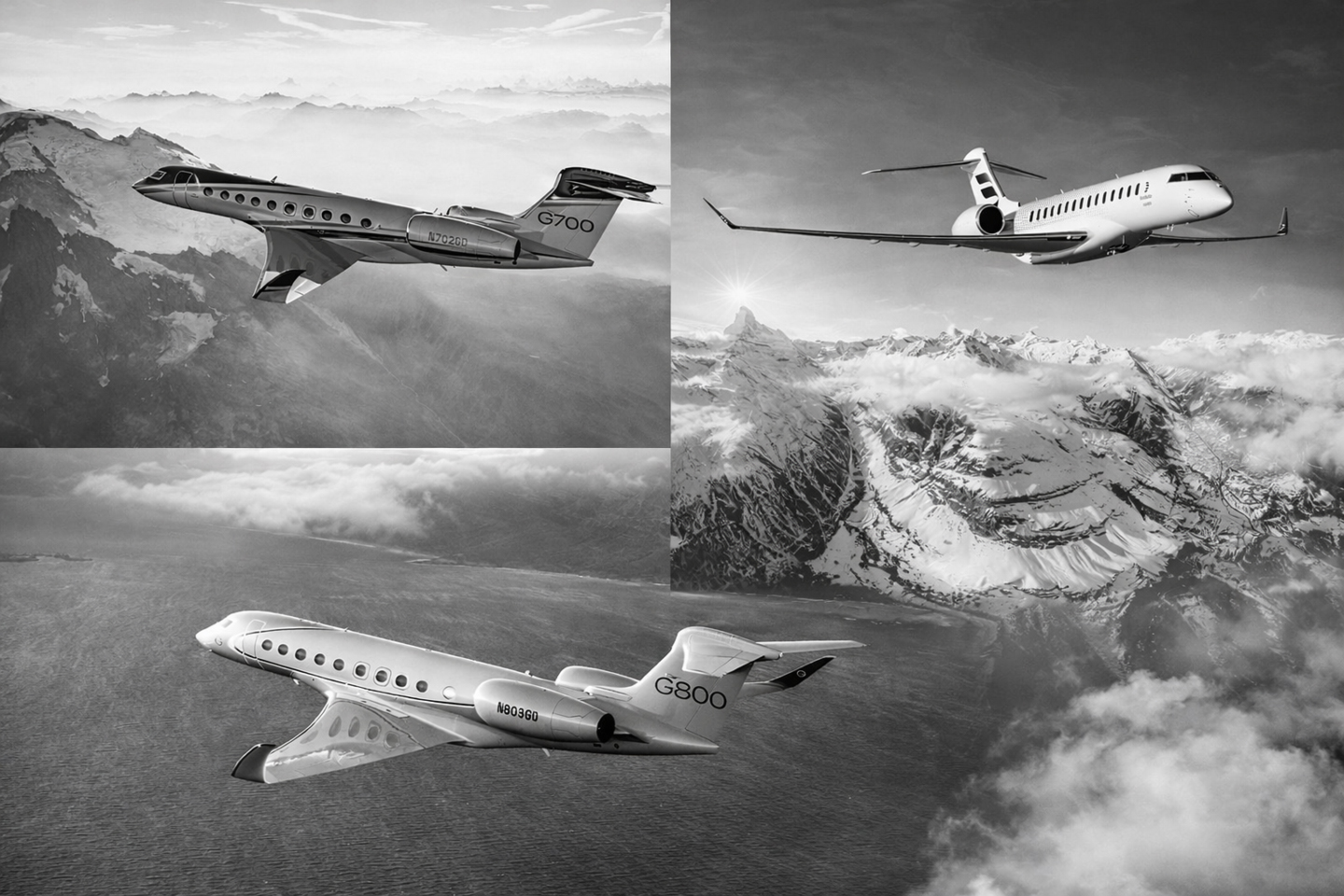
Gulfstream G700 / G800 vs Bombardier Global 7500 / 8000
At the very top of the business aviation market, ultra-long-range jets combine intercontinental non-stop capability, sustained high speed, and true onboard living space. Today, this segment is effectively dominated by two OEMs: Gulfstream Aerospace and Bombardier.
While Dassault’s Falcon 10X is positioned to compete in this segment, it is not included in this analysis as the aircraft has not yet flown and remains in the development and certification phase. As such, its real-world performance and operational capability cannot yet be assessed on a like-for-like basis.
A Market Defined by Real-World Capability
Ultra-long-range aircraft are no longer judged solely on headline range. Advances in aerodynamics, propulsion, and pressurization have shifted buyer focus toward dispatchable performance, sustained high-speed cruise, and passenger comfort on 15 to 17-hour missions.
Both Gulfstream and Bombardier platforms operate efficiently in the Mach 0.85 to 0.90 range for long-range missions, while retaining the certified capability to fly well beyond Mach 0.90 when operationally justified.
Aircraft Positioning
- Gulfstream G700 / G800
Designed around speed, pilot situational awareness, and cabin flexibility, the G700 offers a four-zone cabin while the slightly shorter G800 features a three-zone configuration. Both aircraft are certified to operate up to Mach 0.935, reinforcing Gulfstream’s long-standing emphasis on high-speed cruise capability. - Bombardier Global 7500 / 8000
Bombardier emphasizes range leadership, ride quality, and cabin refinement. The Global 8000, which is replacing the 7500 with an upgrade path for existing owners, further extends the platform’s performance envelope, with a maximum operating speed approaching Mach 0.94, placing it firmly in the same high-speed class as Gulfstream’s latest offerings.
Operational Reality
From an operator’s perspective, the differences are increasingly nuanced:
- Speed: Both platforms are capable of sustained cruise near Mach 0.90 and are certified to exceed it, making speed a tactical option rather than a limiting factor.
- Cabin Comfort: Four-zone cabins, low cabin altitudes (below ~3,000 ft at FL410), optional crew rest areas, and private suites redefine long-haul business travel.
- Technology: Advanced avionics, head-up displays with synthetic vision, and full fresh-air cabin systems are now baseline expectations in this segment.
Price & Market Dynamics
With new aircraft pricing clustered around $80 million USD, acquisition decisions are rarely driven by specifications alone. Buyers increasingly focus on:
- OEM support and delivery availability
- Fleet commonality and training considerations
- Cabin philosophy and interior execution
- Long-term residual value and exit strategy
TSH aviation Perspective
In today’s ultra-long-range market, both Gulfstream and Bombardier deliver aircraft capable of exceptional speed, range, and comfort. The decisive factors are no longer raw performance figures, but how those capabilities align with real missions, payload profiles, airport constraints, and ownership objectives.
At TSH aviation, we translate OEM claims into practical, dispatchable capability, ensuring our clients select the aircraft that best fits their operational reality - not just the most impressive brochure.